

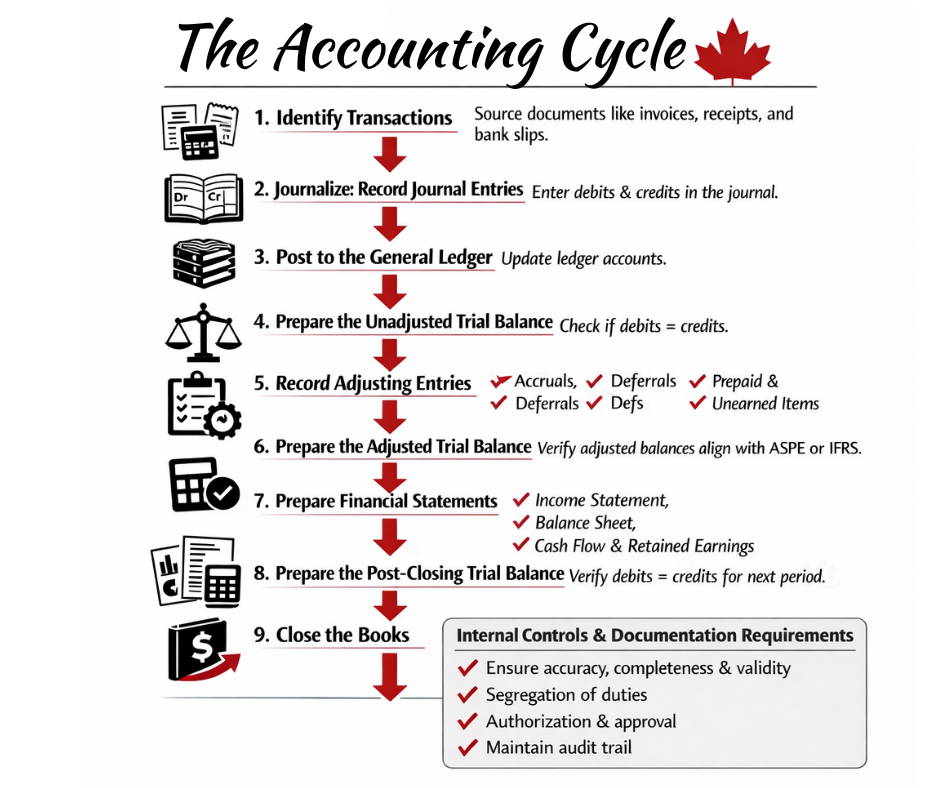
In accounting, the accounting cycle definition refers to the step‑by‑step process businesses use to track, record, reconcile, and summarize financial transactions during a specific reporting period. The accounting cycle ensures that a company’s books stay accurate, organized, and compliant, leading to trustworthy financial statements at month‑end or year‑end.
The accounting cycle is the backbone of bookkeeping for Canadian businesses whether you’re a sole proprietor, a corporation, or a growing organization using cloud accounting software.
(For related fundamentals, see our guides on Bank Reconciliation, Bank Feeds, and the Accounting Equation.)
The 8 Steps of the Accounting Cycle
1. Identify Transactions
Every financial event begins with a source document such as invoices, receipts, bank payments, or POS slips. These documents form the foundation of the audit trail that the CRA expects businesses to maintain.
2. Record Journal Entries
Transactions are entered into the general journal using double‑entry accounting (debits and credits). This ensures financial accuracy and maintains the balance of the accounting equation.
3. Post to the General Ledger
Journal entries are transferred to ledger accounts such as cash, accounts receivable, accounts payable, sales revenue, and expenses creating a running balance for each category.
4. Prepare the Unadjusted Trial Balance
This step checks whether all ledger balances mathematically align. Debits must equal credits before continuing.
5. Record Adjusting Entries
Adjustments ensure revenue and expenses fall into the correct period. These include:
- Accruals
- Deferrals
- Amortization
- Depreciation
- Prepaid expenses
- Unearned revenue
(For context, see Accrual Accounting Definition and Amortization Definition.)
6. Prepare the Adjusted Trial Balance
After adjustments, accountants verify that balances align correctly before generating financial statements.
7. Create Financial Statements
Using the adjusted trial balance, businesses generate key financial reports:
- Income Statement
- Balance Sheet
- Statement of Cash Flows
- Statement of Retained Earnings
These statements are required internally and often for financing, tax filings, and decision‑making.
8. Close the Books
Temporary accounts (revenues, expenses, dividends/drawings) are reset for the next period. Profit or loss is transferred to retained earnings. This signals the end of the accounting cycle.
Why the Accounting Cycle Matters for Canadian Entrepreneurs
Understanding the accounting cycle definition helps business owners:
- Maintain complete and accurate financial records
- Prepare for CRA audits and GST/HST filings
- Ensure payroll and corporate tax obligations are correct
- Monitor cash flow and profitability
- Improve budgeting and financial forecasting
- Identify errors early through reconciliation
Canada’s compliance‑heavy environment makes the accounting cycle critical for avoiding penalties and maintaining clean, reliable books.
(See our posts on Cash Flow Definition and Audit Trail Definition for supporting concepts.)
Cloud Accounting Software and the Accounting Cycle
Modern cloud platforms like Xero, Sage, QuickBooks Online, Sage Intacct, and Oracle NetSuite streamline many parts of the accounting cycle:
- Bank feeds import and match transactions
- Bank rules automate expense categorization
- Recurring invoices simplify revenue processes
- Reports generate automatically
- Audit trail logs all adjustments
- Apps integrate payroll, inventory, and payments
These tools reduce manual work and let accountants focus on higher‑value tasks such as analysis and advising.
(Learn more: Cloud Accounting Software Definition.)
Example: A Small Canadian Startup Applying the Accounting Cycle
A Vancouver‑based e‑commerce startup uses Shopify and QuickBooks Online:
- Identify sales from Shopify orders.
- Record through automatic QBO entries synced via app integration.
- Post via ledger updates from the connection.
- Unadjusted trial balance shows account totals.
- Adjust for merchant fees, inventory changes, and GST/HST owed.
- Adjusted trial balance is compiled.
- Financial statements help the founder assess profitability.
- Books close to prepare for the next month.
This cycle repeats each month helping the owner track trends and prepare for tax season.
Key Takeaway
The accounting cycle definition describes the essential process for organizing and verifying financial transactions from start to finish. For Canadian businesses, mastering the accounting cycle strengthens financial accuracy, supports CRA compliance, improves cash flow insights, and sets the stage for informed decision‑making.
Whether you manage your books manually or use cloud accounting software, following a structured accounting cycle ensures your financial records remain clean, accurate, and audit‑ready.


