

When learning accounting, one of the first and most important concepts to grasp is debits and credits. These two terms form the foundation of the double-entry accounting system also known as accrual accounting, which ensures that every financial transaction is recorded accurately and in balance.
The T-Account – A Visual Tool
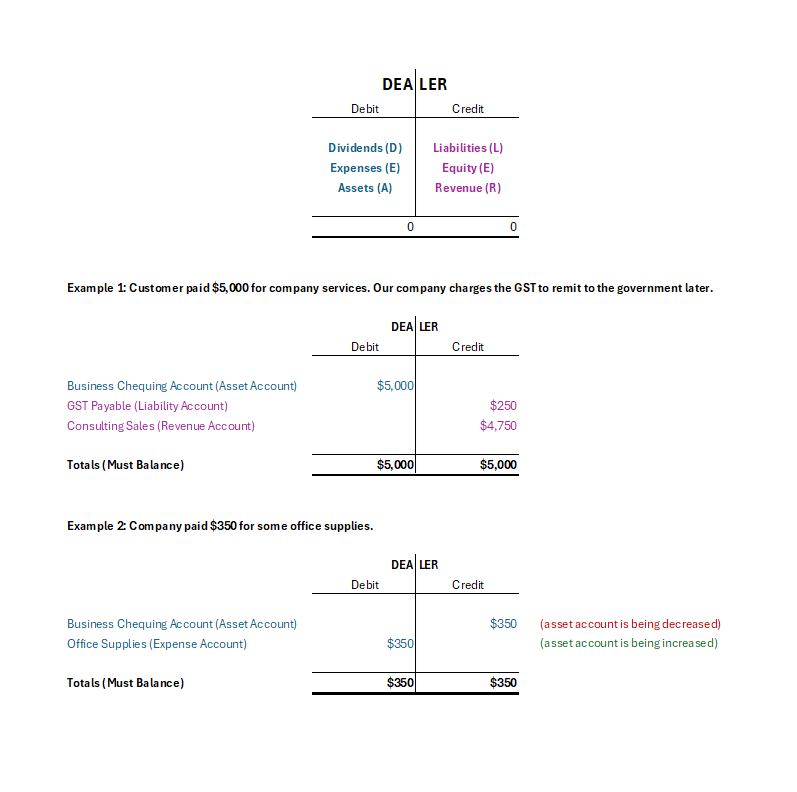
To visualize debits and credits, accountants often use T-accounts. Picture a letter “T” on paper:
The left side represents debits
The right side represents credits
When a transaction occurs, it is recorded on both sides of the T-account. Debits increase certain types of accounts, while credits increase others. Importantly, in accrual accounting, total debits must always equal total credits. This is what keeps the accounting equation in balance.
The DEALER Acronym
A helpful way to remember how debits and credits work is by using the acronym DEALER.
D – Dividends/Drawings
E – Expenses
A – Assets
L – Liabilities
E – Equity
R – Revenue
The first three (D, E, A) are debit accounts, meaning they increase with a debit.
The last three (L, E, R) are credit accounts, meaning they increase with a credit.
Note: When remembering the acronym always remember the side of the increase. If you have to decrease the account you would show the amount on the opposite side of the T-account.
Breaking Down the DEALER Acronym
D – Dividends/Drawings
When a company pays dividends to shareholders or when an owner withdraws money from the business, this account increases.
Normal Balance is a Debit. Which means an increase to the Dividends/Drawings account will show up as a debit on the left side of a T-account.
E – Expenses
Costs incurred in operating the business, such as advertising, rent, salaries, or utilities.
Normal Balance is a Debit. Which means an increase to the Expense account will show up as a debit on the left side of a T-account.
A – Assets
Assets are what the company owns. Items of value that can generate future benefits. Example: Current Assets may include cash, accounts receivable, inventory, prepaid expenses. Capital or Long-term Assets may include Long-term investments, intangible assets like patents, trademarks, licences, franchises, goodwill, property, plant, vehicles, machinery and equipment.
Normal Balance is a Debit. Which means an increase to the Asset account will show up as a debit on the left side of a T-account. 4
L – Liabilities
Liabilities are obligations the business owes to others. Current Liabilities may be accounts payable, credit card balances, short-term bank loans, government remittances payable (payroll source deductions, HST/GST). Long-Term Liabilities may be mortgages, bonds payable, long-term bank debt.
Normal Balance is a Debit. Which means an increase to the liabilities account will show up as a debit on the left side of a T-account.
E – Equity
Equity is what the shareholders or owners would receive if all the company’s assets were sold and all its debts were paid off. Equity accounts may include retained earnings, common stock, preferred stock, owners’/shareholders’ equity. Example: A credit to Owner’s Equity when an owner invests capital into the company.
Normal Balance is a Debit. Which means an increase to the equity account will show up as a debit on the left side of a T-account.
R – Revenue
Income earned from providing goods or services. Example: A credit to Service Revenue when completing a consulting project.
Normal Balance is a Debit. Which means an increase to the revenue account will show up as a debit on the left side of a T-account.
Why It Matters
Understanding debits and credits and applying the DEALER rule ensures that:
Transactions are recorded accurately.
The accounting equation stays in balance.
Financial statements like the Balance Sheet and Income Statement reflect a true picture of the company’s financial health.
Accountants use the DEALER acronym as a memory aid to correctly record transactions by classifying account types and understanding their normal balances. By mastering T-accounts and the DEALER acronym, you’ll have a strong foundation for interpreting financial records and making informed business decisions.