

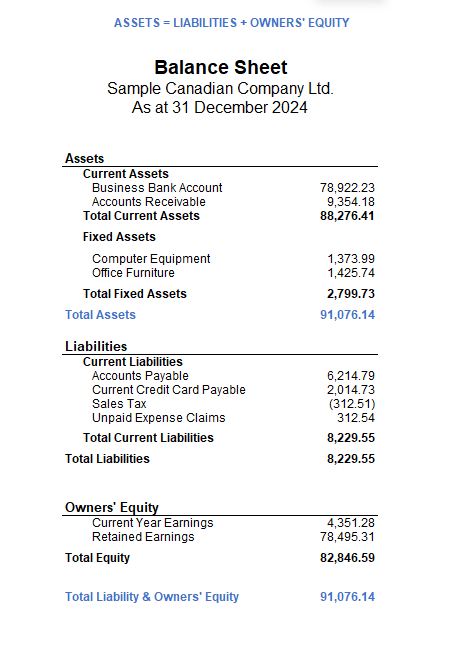
In accounting, a balance sheet definition refers to a financial statement that shows a company’s assets, liabilities, and equity at a specific point in time. The balance sheet helps Canadian businesses understand what they own, what they owe, and the value that belongs to the owners.
The balance sheet is one of the core financial statements, alongside the income statement and cash flow statement, and it follows the accounting equation used throughout Canadian bookkeeping.
What Is a Balance Sheet?
A balance sheet is a snapshot of a business’s financial position on a particular date usually year‑end or month‑end. It lists:
- Assets (what the business owns)
- Liabilities (what the business owes)
- Equity (value remaining for owners after debts are paid)
The balance sheet must always stay in balance following the accounting equation:
Assets = Liabilities + Equity
(For more detail on the equation, see our [Accounting Equation Explained] article.)
Balance Sheet Definition in Accounting
The balance sheet definition includes three major sections:
1. Assets
Resources that provide economic value, recorded as:
- Current assets: cash, accounts receivable, inventory
- Non‑current assets: equipment, buildings, vehicles, intangibles
Learn more: [Asset Account Definition]
2. Liabilities
Obligations owed to others, such as:
- Current liabilities: accounts payable, GST/HST payable, credit cards
- Long‑term liabilities: loans, mortgages, leases
Learn more: [Liability Account Definition]
3. Equity
Owner value in the business, which may include:
- Share capital
- Retained earnings
- Owner’s drawings or dividends
Learn more: [Equity Account Definition]
Together, these sections form the balance sheet and demonstrate the financial health of the business.
Example: Balance Sheet for a Small Canadian Retail Business
Here is a simplified example using common Canadian chart‑of‑accounts categories:
Assets
- Cash: $8,000
- Accounts Receivable: $12,000
- Inventory: $20,000
- Equipment (net): $15,000
Total Assets = $55,000
Liabilities
- Accounts Payable: $9,500
- Credit Card Payable: $2,500
- Bank Loan: $10,000
Total Liabilities = $22,000
Equity
- Share Capital: $15,000
- Retained Earnings: $18,000
Total Equity = $33,000
Balance Check:
Assets $55,000 = Liabilities $22,000 + Equity $33,000 ✔️
Why the Balance Sheet Matters for Canadian Entrepreneurs
The balance sheet is essential for:
- Assessing business health
- Tracking debt levels
- Planning cash flow
- Evaluating growth over time
- Supporting loan applications
- Preparing year‑end financial statements
- Filing accurate corporate taxes with the CRA
The balance sheet also ties directly into GIFI codes used on the T2 return.
(If you’re mapping accounts, see our guide on [GIFI Codes for Corporations].)
Balance Sheet and CRA Reporting Requirements
Corporations filing a T2 return must submit their balance sheet using CRA’s GIFI (General Index of Financial Information) codes.
Examples:
- 2599 – Total Assets
- 3499 – Total Liabilities
- 3620 – Total Shareholder Equity
More: [General Index of Financial Information Guide]
The balance sheet also forms part of a business’s audit trail and record‑keeping obligations.
For full retention rules, see: [Audit Trail Definition]
How the Balance Sheet Connects to Other Financial Statements
A complete financial reporting system includes:
- Balance Sheet → shows financial position
- Income Statement → shows performance over a period
- Cash Flow Statement → shows cash inflows and outflows
Changes in income and expenses flow into retained earnings, which affects the equity section of the balance sheet.
Key Takeaway
A balance sheet definition describes a snapshot of a company’s financial standing at a point in time. It shows what a business owns, what it owes, and the owner’s equity. For Canadian businesses, the balance sheet is essential for tax filings, financial reporting, decision‑making, and maintaining compliance with the CRA.
A well‑structured balance sheet helps entrepreneurs understand their true financial position and plan for sustainable growth.