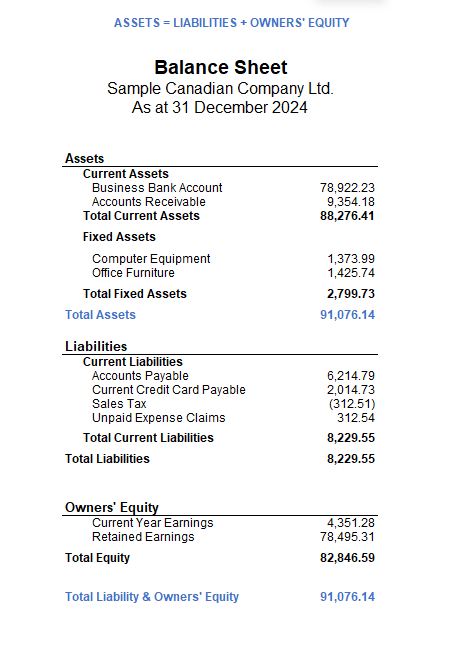


Every successful business, whether it’s a small Canadian startup or a large corporation listed on the Toronto Stock Exchange, relies on one simple but powerful formula:
Assets = Liabilities + Owners’ Equity
This is called the accounting equation, and it provides the foundation for the double-entry method of accounting. Understanding it is essential for entrepreneurs, professionals, and investors who want to read financial statements and evaluate the financial health of a company.
Breaking Down the Accounting Equation
Assets
Current Liabilities
Assets represent everything a business owns that holds value and can generate future benefits.
Current Assets
- Cash
- Accounts receivable
- Inventory
- Prepaid expenses
Non Current Assets
- Long-term investments
- intangible assets like patents or goodwill
- Short-term bank loans
- Government remittances payable (payroll source deductions, HST/GST)
Capital Assets
- Property, plant, and equipment used in daily operations
- These assets depreciate over time
Capital Assets: Property, plant, and equipment. These are used in day-to-day operations and depreciated over time.
Liabilities – What the Company Owes
Current Liabilities
Liabilities are financial obligations the company must settle.
- Accounts payable
- Credit card balances
- Short-term bank loans
- Government remittances payable (payroll source deductions, HST/GST)
Long-Term Liabilities
- Mortgages
- Bonds payable
- Long-term bank debt
Owners’ Equity
Owners’ equity is what remains after subtracting liabilities from assets. In corporations, this is called shareholders’ equity.
It Includes:
- Share capital
- Retained earnings
- Dividends declared
The Balance Sheet and the Accounting Equation
The balance sheet is a financial snapshot that puts the accounting equation into practice. It shows a company’s assets, liabilities, and owners’ equity at a specific point in time.
Here’s how it’s typically structured:
- Assets appear at the top
- Liabilities are listed next
- Owners’ Equity comes last
Importantly, the total assets must always equal the sum of liabilities and owners’ equity. This balance is what makes double-entry accounting reliable and accurate.
Why the Accounting Equation Matters
Accuracy
Double-entry bookkeeping ensures every transaction affects at least two accounts, keeping the books balanced.
Transparency
Investors, lenders, and the CRA (through financial statements like the T2 corporate return and GIFI schedules) rely on this structure to assess financial health.
Decision Making
The balance sheet helps owners and managers plan, budget, and evaluate growth opportunities.
Final Thoughts
The accounting equation Assets = Liabilities + Owners’ Equity is more than just a formula. It’s the blueprint behind every balance sheet, the foundation of double-entry accounting, and a key tool for financial reporting in Canada.
Whether you’re filing a T2 return or analyzing a company’s financials, mastering this equation helps you understand how money flows through an organization and how financial health is measured.